How Much Does It Cost to Move a Mobile Home in 2026?
Most people pay between $3,000 and $20,000 to move a mobile home in 2026, and the final figure depends far more on size, distance and setup than on any single quote you find online. A single wide that travels a short distance often lands near $3,000 to $9,000 with setup included. A double wide usually runs $7,000 to $16,000. Triple wides and long interstate hauls can pass $30,000.
Those numbers come from comparing a dozen current cost guides, mover directories and county fee schedules, and the sources do not agree with each other. This guide explains why, shows what every line of a quote pays for, and walks through three sample budgets so you can see where your own move is likely to fall. If you are crossing a state line, the later sections cover the extra permits and paperwork that an out of state relocation adds.
Mobile home moving cost by home size
Size is the first thing any mover asks about, because it decides how many sections travel, how many rigs are needed and how wide the load is on the road. The table shows what published 2026 guides report for local moves.
| Home type | Transport only | Move plus setup | What drives the spread |
| Single wide | $1,500 to $5,000 | $3,000 to $9,000 | One section, lighter load, fewer escorts |
| Double wide | $3,500 to $10,000 | $7,000 to $16,000 | Two sections, two rigs, reassembly on site |
| Triple wide | $6,000 to $15,000 | $10,000 to $30,000+ | Three sections, longer permits, bigger crew |
Ranges merge national cost guides and mover directories. Transport only means towing and delivery without setup.
Angi’s 2026 data gives a national average near $9,000, with most moves between $5,000 and $20,000. That sits comfortably in the middle of the ranges above, which is a good sign that the table reflects what homeowners actually pay rather than a marketing floor.
Why the prices you find online do not match
Search this topic and you will see opening prices around $1,000 to $5,000 next to totals above $30,000. Both can be honest. The gap usually comes from scope. A transport only quote covers hooking up and hauling the home, sometimes with permits. A full service quote adds teardown, escorts, blocking, leveling, tie downs and utility reconnection. Some guides also quote per mile rates that are easy to misread, because a double wide travels as two sections and each section is billed on its own.
Three questions keep you from comparing the wrong things. Is this a firm quote or an estimate? Which permits and which escort vehicles are included? What happens at the destination? Delivered does not always mean set up and livable, and a low quote that stops at the curb can cost more than a full service price once you hire a separate installer.
What a mobile home move costs, line by line
Towing and transport
Short moves often hit a minimum charge, so a two mile trip and a twenty mile trip can price almost the same. Beyond roughly 50 miles most movers switch to a per mile rate, and published rates range from about $4 to $15 per mile per section depending on region, equipment and home size. For a double wide that adds up quickly: 100 miles across two sections at $4 to $15 means $800 to $3,000 for towing alone, before any other line item.
Permits, taxes and clearances
Permits are small money with large consequences. A single trip oversize permit in North Carolina carries a base fee of about $36 to $48, while Cumberland County in the same state lists $200 for a single wide placement permit, $300 for a double wide and $150 for a tie down permit. One Georgia county charges a flat $1,000 relocation permit. Fees depend on the road, the county and the destination, so ask the mover whether permits are included or passed through at cost.
Pilot cars and escorts
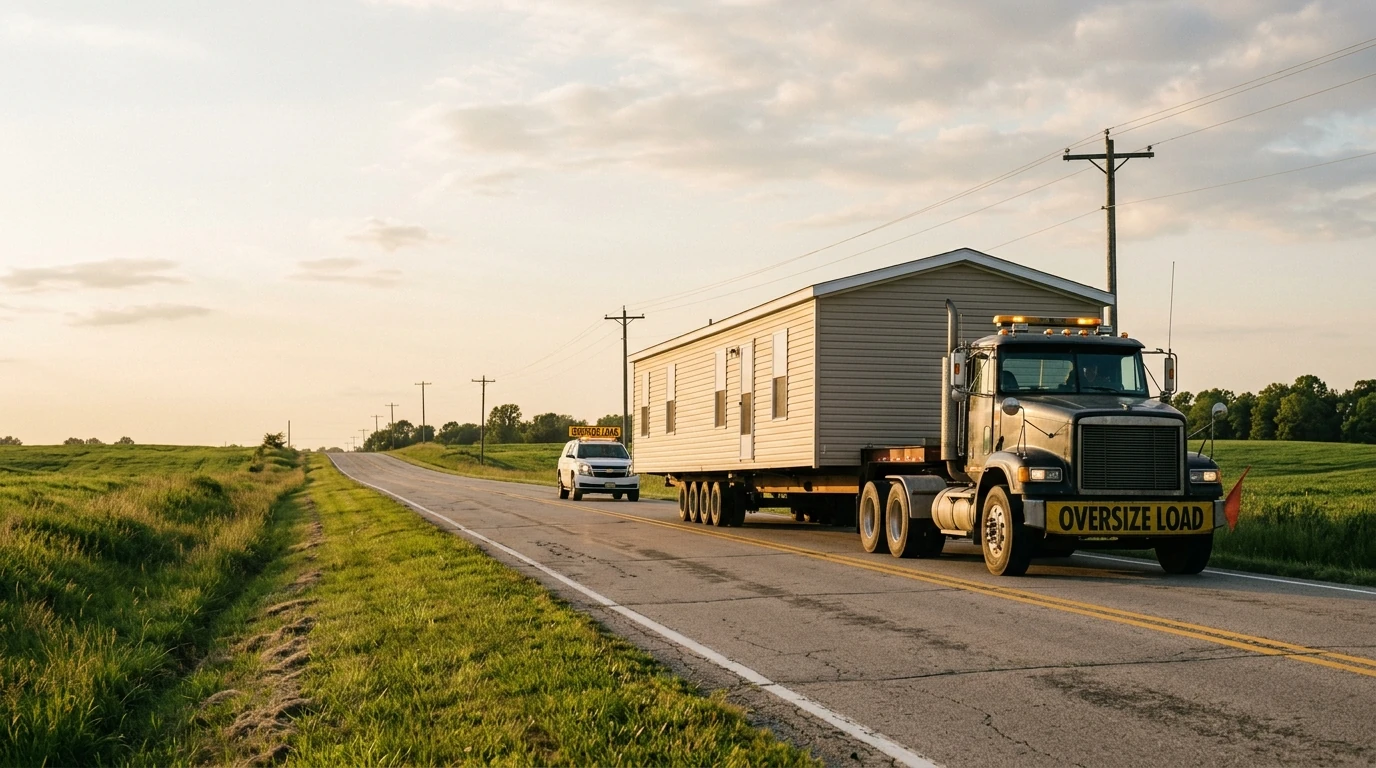
Wide loads usually need pilot cars, and the number depends on state rules and how wide the home is. Published rates run $1.50 to $3.50 per mile for each escort vehicle. Two escorts over 100 miles would cost roughly $300 to $700. Some routes need a police escort or a scheduled road closure, and those are priced separately.
Teardown, prep and setup
Before the home can roll, crews disconnect utilities, remove skirting, steps and decks, separate sections on multi section homes and check the axles, tires and hitch. At the new site they block, level, anchor and reconnect. Angi puts setup near $3,000 to $4,000 on a prepared lot, other guides report up to $7,000 for double wides, and raw land costs more. Some places require licensed installers, including Texas and Cumberland County, so you cannot always save money by doing this part yourself.
Utilities, site work and finishing
One North Carolina mover directory lists water tap fees of $763 to $2,620, sewer taps of $1,406 to $1,660 and new skirting from $630 to $4,480 for that county. Treat those as a local sample, not a national average, but they show how quickly hookups and finishing work add up. Ask the lot owner or park manager what utilities already exist before you book a date.
Insurance and a contingency cushion
Confirm the mover’s liability and cargo coverage in writing, and check whether your own homeowner or park policy covers the home in transit. Mover directories commonly suggest holding back $1,000 to $3,000 for delays, repairs and surprises, and that is a sensible number for any move that involves a decades old structure.
How distance changes the price
Distance shapes the price in three stages. Local moves under about 50 miles are mostly minimum fees plus teardown and setup. Regional moves of 100 to 250 miles bring per mile charges, escorts and more permit paperwork. Beyond that, one directory puts transport only costs for a 1,000 mile haul at $10,000 to $15,000 for a single wide and $15,000 to $25,000 or more for a double wide.
Interstate moves add a layer that local moves skip. Every state you cross issues its own oversize permit and sets its own rules on dimensions, travel windows and escorts. OSG’s moving cost by distance calculator shows how mileage reshapes a household move. A home haul follows its own rate card, but the same pattern holds: each extra state and each extra hundred miles adds cost faster than most people expect.
Three sample budgets
These planning ranges are built from the published figures above. They are not quotes, and your own mover will price the real route and site, but they give you a realistic target before you start calling.
| Scenario | Planning range | Biggest cost drivers |
| Single wide, 25 miles, same county | $3,000 to $8,000 | Minimum charge, tie down permit, setup on a prepared lot |
| Double wide, 100 miles, same state | $9,000 to $16,000 | Two sections, two escorts, reassembly, county placement permit |
| Double wide, 800 miles, interstate | $15,000 to $30,000+ | Permits in every state, per mile towing, setup at a new site |
Permits and paperwork before the home can roll
A mobile home cannot simply be hitched and driven away. Three layers of paperwork stand between you and moving day, and a missing document can stall the move for weeks.
The first layer is tax clearance. Arizona requires a tax clearance, called Form 504, from the county assessor to move a manufactured home, and state law makes it unlawful to move or sell one with unpaid property taxes. A Washington county requires a tax certificate plus a moving permit, and it collects the next year’s tax in advance when the home leaves the county. The second layer is the transport permit. Texas, for example, requires a moving permit for city and county roads and a bonded, licensed installer at the other end. The third layer is title and ownership. In Texas the owner files for a new statement of ownership within 60 days of the move, and in Arizona a home removed from its parcel must be re titled through the state motor vehicle division. Lien releases are needed wherever a lender is involved.
Age matters too. The federal HUD Code took effect on June 15, 1976, and homes built before that date are the ones the industry calls mobile homes rather than manufactured homes. Many counties and parks restrict or refuse older units, and one Georgia county’s relocation rules bar homes built before 1976 from moving in or out. Check the destination rules before you pay for a single mile of towing.
Can you move a mobile home yourself?
Almost never. Cost guides, including Angi’s, treat professional movers as effectively required, because the job involves oversize permits, specialized towing equipment, pilot cars, insurance and, in many places, licensed installers. One 50 mile comparison found do it yourself costs of roughly $6,300 to $15,600 against $6,700 to $12,700 for professionals once equipment, permits and setup were counted, so the savings tend to vanish while the risk stays.
Is it worth moving, or cheaper to sell?
A new manufactured home commonly costs $40,000 to $100,000 or more, which makes a $12,000 move look like a bargain. The comparison is only fair if you include the new lot or park fees, site preparation and the age of the home itself. Older single wides are the weakest candidates. They are the models most likely to be restricted by zoning, and Wikipedia’s overview of manufactured housing notes that many jurisdictions limit or forbid single wide placement altogether.
If the quote lands close to what the home is worth, selling or removing it may win. Angi lists demolition and debris removal at $3,000 to $5,000 for a single wide and $4,000 to $7,000 for a double wide, and some buyers advertise free removal for homes that are not worth moving. Run your numbers through the sell it or move it calculator, and if you clear the home out first, check dumpster rental costs so the cleanup does not surprise you.
Moving a mobile home to another state
Moving the home itself is only one part of an out of state relocation. Confirm that your mover is licensed for interstate work and carries a USDOT number, and use the USDOT number lookup to check it before you pay a deposit. The guide to how to hire interstate movers covers contracts and red flags, and what an interstate move costs helps you budget for your belongings, vehicles and travel on top of the home.
Plan for the destination early. The new resident DMV checklist covers title and registration steps, and the state tax residency checklist helps you sort out the tax side. Before you choose a lot or park, compare housing and everyday costs on the cost of living by state rankings, because a cheaper lot rent can be wiped out by higher insurance or utility costs. Bring everything together in the moving out of state checklist and the moving budget calculator.
How to get an accurate quote and keep the price down
Ask for an onsite inspection, because phone quotes miss the things that cost money: tight turns, low branches, soft ground and a frame that is weaker than it looks. Give each mover the exact pickup and delivery addresses, the make, model year and dimensions of the home and a clear list of services you want. Then collect itemized written quotes from at least three licensed companies and compare them line by line, not by the bottom number.
Several choices lower the bill without cutting corners. Remove skirting, decks, steps and personal belongings before the crew arrives, if the mover allows it. Schedule outside peak season, since one guide reports lower prices in fall and winter. Keep the route short, bundle transport and setup with one company, and ask whether a local utility will disconnect and reconnect services for less than the mover charges.
Mistakes that quietly add thousands
Five mistakes cause most of the surprises. Homeowners sign a lot lease before confirming that the park or county accepts a home of that age and size. They skip the tax and lien clearance and discover the problem on moving day. They compare a transport only quote with a full service quote. They accept a price without an inspection. And they forget a contingency, so a cracked axle or a delayed permit turns into a payment problem. If your belongings will wait while the home is set up, price that gap with the storage cost calculator.
Comparison Tables and Checklists
Questions to ask every mover
| Question | Why it matters |
| Is this a firm quote or an estimate? | Estimates can rise on moving day, firm quotes cannot. |
| Are permits and escort vehicles included? | These are the lines most often left out of a low price. |
| Will you inspect the home and route in person? | Phone quotes miss tight turns, soft ground and weak frames. |
| Do you handle teardown, blocking, leveling and tie downs? | Setup can add $3,000 to $7,000 if it is separate. |
| Who arranges tax clearance and lien releases? | Unpaid taxes can stop the move. |
| Are you licensed and insured for my route, including interstate? | Licensing and coverage protect you if the home is damaged. |
| What happens if the route changes or a permit is delayed? | Change fees and delays are common surprise charges. |
| What is the cancellation and rescheduling policy? | Weather and permit delays can move the date. |
Documents to line up before moving day
| Document | Usually issued by |
| Tax clearance or tax certificate | County assessor or treasurer |
| Lien release | Your lender or lienholder |
| Title or statement of ownership | State housing or motor vehicle agency |
| Transport and oversize permits | State transportation department, often arranged by the mover |
| Placement permit and inspection | Destination county or city building office |
| Proof of mover insurance | The moving company |
Names and requirements vary by state and county. Confirm each item with the local office.
FAQ
How much does it cost to move a mobile home?
Most moves cost $3,000 to $20,000 in 2026, with a national average near $9,000. Transport only prices are lower, and triple wides or interstate hauls can exceed $30,000.
How much does it cost to move a single wide?
Expect about $3,000 to $9,000 with setup for a local move. Transport only can run $1,500 to $5,000 if the home is ready and the new site is prepared.
How much does it cost to move a double wide?
A double wide typically costs $7,000 to $16,000 with setup. It travels in two sections, so towing, escorts and reassembly all run higher than for a single wide.
How much does it cost to move a mobile home 50 miles?
A 50 mile move with setup usually falls between $5,000 and $10,000 for a single wide and $9,000 to $16,000 for a double wide, depending on the route and site.
What is the cost per mile to move a mobile home?
Published rates run from about $4 to $15 per mile per section, plus $1.50 to $3.50 per mile for each escort car. Short moves often have a flat minimum instead.
Do I need a permit to move a mobile home?
Yes. Expect a transport permit for the roads you use, a tax clearance showing property taxes are paid and, at the destination, a placement permit and inspection. Rules vary by state and county.
Can I move a mobile home built before 1976?
Sometimes, but many counties and parks restrict homes built before the 1976 HUD Code, and older frames carry more risk in transit. Confirm the destination rules before you book.
Is it cheaper to buy a new mobile home than move one?
Often not. New manufactured homes commonly cost $40,000 to $100,000 or more, but older homes can be so costly to move or place that selling or removing them is the better choice.