Best Lock for Storage Unit: How to Choose One That Fits and Holds
The best lock for a storage unit is usually a disc lock made of stainless or hardened steel. A cylinder lock is the better choice when your facility builds its doors for one. Extra Space, for example, points renters to disc locks. The catch is that your door decides which type you can use, and that is the step most buying guides skip.
This guide shows you how to check your door first, then pick a lock that matches it. It also covers what a lock cannot protect against, which matters even more if you are storing items between states.
What Is the Best Lock for a Storage Unit?
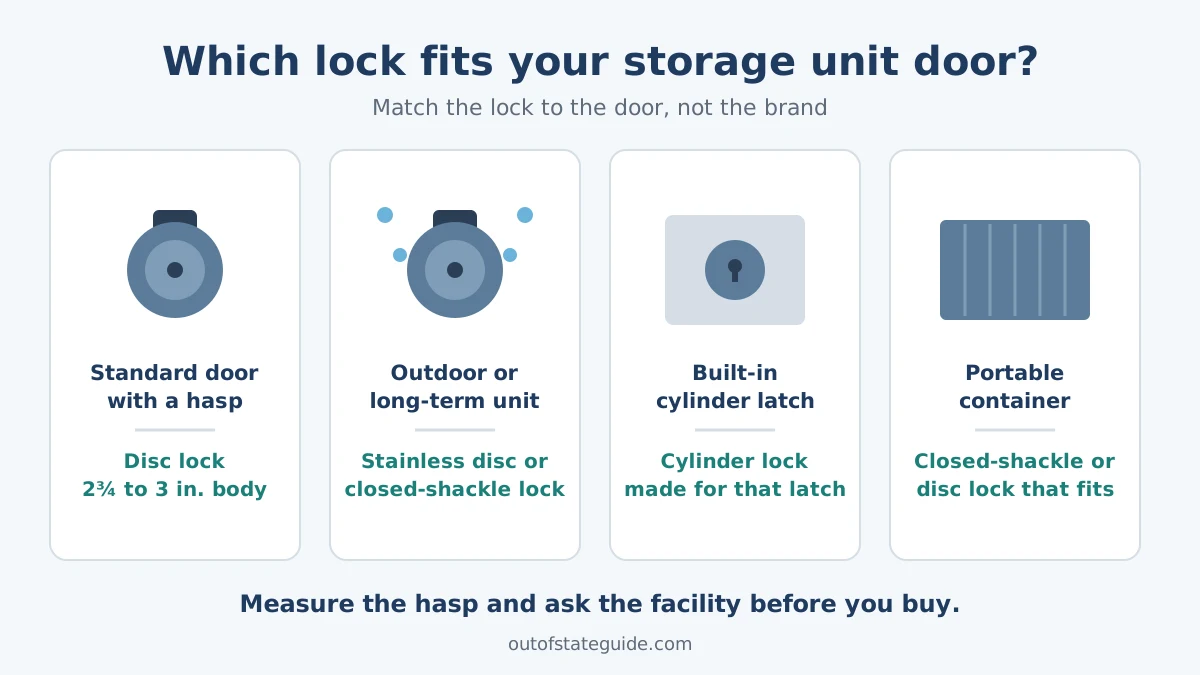
For most units with a standard hasp, a disc lock is the best fit. A disc lock exposes only a sliver of shackle, so bolt cutters have little to grab. If your facility uses a built-in cylinder latch, buy the cylinder lock made for that latch. For containers or outdoor units, pick a closed-shackle lock in stainless or hardened steel.
Quick Pick Table: Match the Lock to Your Situation
| Your situation | Best-fit lock | Check first |
|---|---|---|
| Standard door with a hasp, indoor unit | Disc lock, roughly 2¾ to 3 inch body | Hasp opening size, facility rules |
| Same door, outdoors or humid area, long stay | Stainless disc lock or closed-shackle hardened padlock | Corrosion resistance, spare keys |
| Door with a built-in cylinder latch | Cylinder lock sold for that latch | Ask the office for the model |
| Portable container (PODS, U-Box style) | Disc or closed-shackle lock that fits the container hasp | Provider guidance |
A Note on Portable Containers
U-Haul’s own product Q&A says its discus lock does not fit a U-Box. Always confirm fit with the provider before you buy.
Check What Your Door Accepts Before You Shop
Buying first and measuring later is the most common way to end up with a lock that does not fit. Do this instead.
Step 1: Look at the Door Hardware
You will see either a hasp (a metal loop or plate with a hole) or a built-in cylinder slot.
Step 2: Measure the Hasp Hole
A shackle about 3/8 inch thick with a 7/8 inch opening suits most storage hasps. Take a phone photo with a ruler or tape measure in frame.
Step 3: Ask the Office Two Questions
Ask what lock sizes or types they require, and what happens if you lose a key. Facilities set their own rules, so check before buying.
Many units have two hasps. One is for your lock and one lets the facility lock you out if rent goes unpaid. Facilities routinely cut locks off for nonpayment, so read your lease for what it allows.
Disc Lock, Cylinder Lock, Closed-Shackle Padlock or Combination Lock?
| Type | Cut resistance | Pick resistance | Weather | Typical cost | Best for | Watch out |
|---|---|---|---|---|---|---|
| Disc lock | High (shackle mostly hidden) | Varies by model | Good in stainless | About $15 to $40 for common models | Most standard hasps | Needs enough hasp clearance |
| Cylinder lock | High (nothing exposed) | Good | Good | Often $30 to $50 | Doors built for cylinders | Only works with that latch |
| Closed-shackle padlock | High | Good on premium models | Very good | About $40 to $130 | Outdoor, long-term, valuables | Heavy, pricier |
| Standard open-shackle padlock | Low | Varies | Varies | Under $30 | Low-value contents only | Shackle is easy to reach |
| Combination lock | Varies | Often weaker | Varies | Low | Short-term, low risk | Many facilities will not accept it as the primary lock |
Price bands come from retail ranges in 2026 roundups: Master Lock $13.99 to $36.45, Brinks $18.99 to $23.69, ABUS $27.99 to $149.50, and $40 to $130 for a quality closed-shackle padlock. Treat them as rough guides and check current listings.
Disc Locks
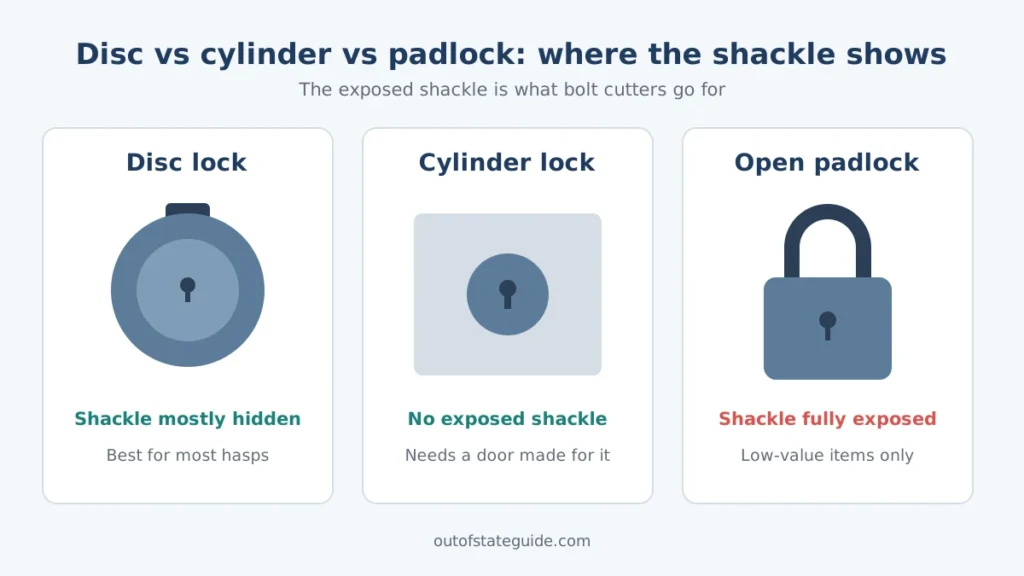
The shackle sits almost fully inside the body, so a bolt cutter has little to close around. This is the default pick for standard hasps.
Cylinder Locks
The whole mechanism sits inside the door, so there is no exposed shackle. They only work on doors made for them, and some facilities sell the required model at the office.
Closed-Shackle Padlocks
A heavy body wraps the shackle. They cost more, but they suit outdoor units and long stays where weather and tools are both a concern.
Combination and Smart Locks
Combination locks suit short, low-risk storage only. Neighbor’s 2026 roundup skipped smart locks because most facilities do not recommend them. If you want one, ask the facility first.
Locks Worth Shortlisting
OSG has not tested these. They appear repeatedly in 2026 roundups, so they are a reasonable place to start comparing:
- ABUS Diskus (disc lock) and ABUS Granit 37 series (closed shackle)
- Master Lock discus and Magnum shrouded padlocks
- Brinks stainless discus padlock for a lower budget
What No Lock Can Do
A lock slows a thief down. It does not stop a determined one. One locksmith-community thread notes that angle grinders and hydraulic bolt cutters are the two biggest threats to padlocks, and that the hasp or door may be easier to compromise than the lock itself.
So do not spend $150 on a lock if the door it sits on is flimsy. Put your money where the weak link is, and look at facility security as well: gated access, cameras, lighting and how entries are logged.
Padlock performance also has a published standard. ASTM F883 covers forcing, covert-entry and environmental tests for padlocks. If a product lists a grade or test standard on its spec sheet, that is more useful than marketing language.
Locking Up a Storage Unit in Another State
This is where a lock choice gets more consequential. If you are moving between states and your belongings are in a unit you will not see for months, you cannot pop over to fix a problem. Plan for it.
Before You Leave
- Buy before you leave. Test the lock on the actual hasp while you are still local.
- Get keyed-different locks and make spares. Keep one key with you and give one to a trusted person near the unit. Do not mail keys.
- Photograph everything. Take pictures of the lock in place, the door, and the unit interior on the day you close it up.
After You Move
- Update your billing address so facility notices reach you. Our change of address checklist covers it.
- Budget for the whole storage period. Use the storage cost calculator and the moving budget calculator so a long gap does not surprise you.
If you are comparing containers with facility units, our guide to truck and container options is a good next step, and how to hire interstate movers explains storage-in-transit questions to ask.
Does Your Insurance Care Which Lock You Use?
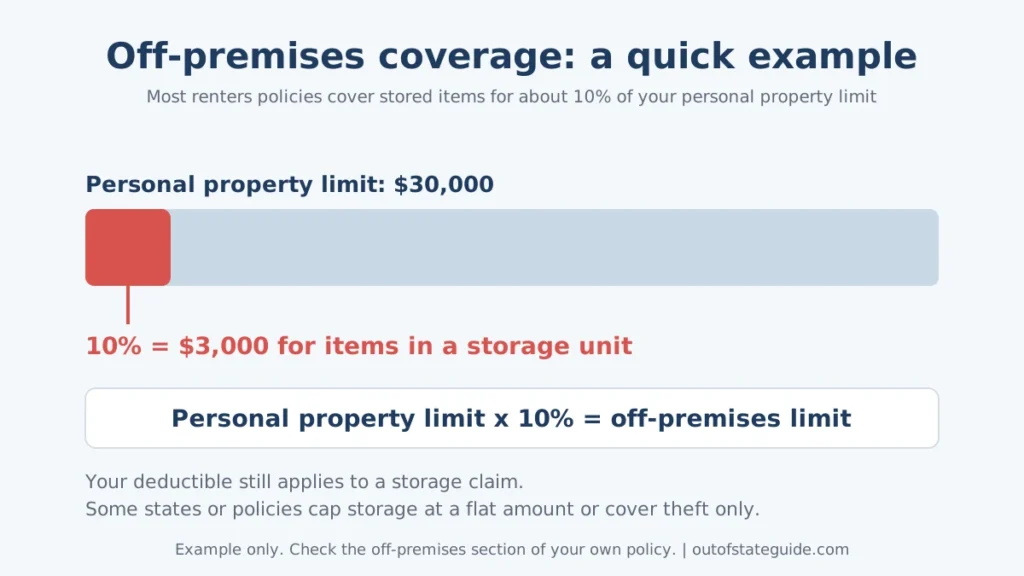
Insurance is separate from the lock, but the two work together. Renters policies typically cover stored property up to 10% of your personal property limit, so a $30,000 limit gives $3,000 for storage. Your deductible still applies, and in some states insurers can cap off-premises coverage at a flat $1,000. Some policies also limit off-premises coverage to theft only.
Add up what you are storing. If it exceeds your off-premises limit, a better lock will not close that gap. Raise your limit or buy storage coverage instead. Read the off-premises section of your policy before you move anything in.
Mistakes That Cost People Their Locks (or Their Stuff)
- Buying the lock before checking facility rules or measuring the hasp
- Buying a multipack that is keyed alike when you need separate keys
- Leaving the lock hanging open on the hasp where someone can swap it
- Skipping spare keys, then paying for a locksmith or lock cut
- Putting an expensive lock on a weak door
- Skipping a light lubricant check on outdoor locks, because a rusty lock becomes a stuck lock
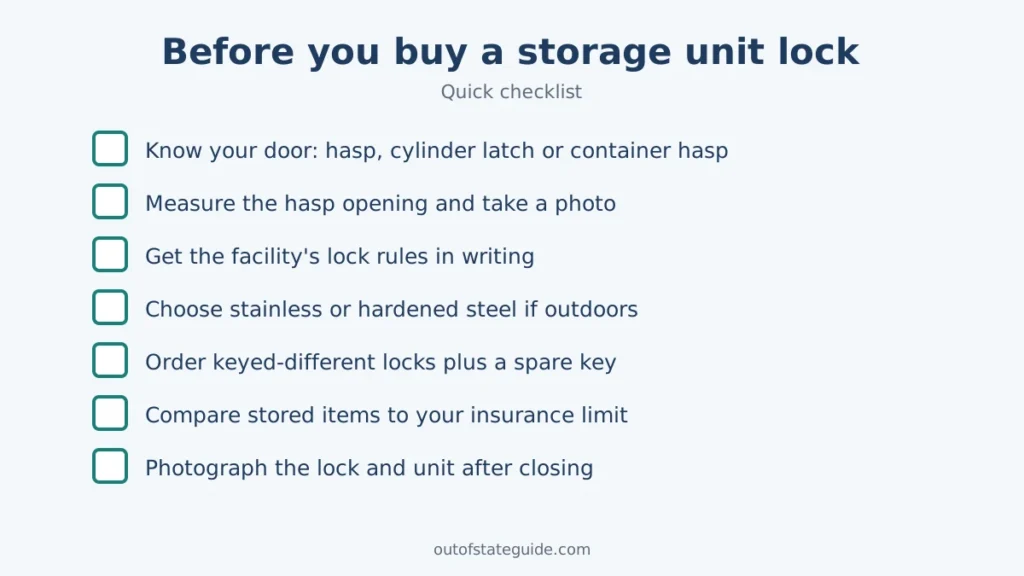
Quick Checklist Before You Buy
- I know whether my door uses a hasp, a cylinder latch or a container hasp
- I measured the hasp opening and have a photo
- The facility confirmed its lock requirements in writing
- I chose stainless or hardened steel if the unit is outdoors
- I ordered keyed-different locks and a spare key
- I compared the value of my items to my off-premises insurance limit
- I photographed the lock and unit after closing it
Frequently Asked Questions
What’s the best lock for a storage unit I won’t visit for months?
A stainless or hardened-steel disc lock or closed-shackle padlock that fits your hasp. Buy keyed-different locks, keep a spare key, and photograph the setup before you leave.
Can I use my own lock on a storage unit?
Usually yes, but the facility sets the rules. Ask about required lock type and size before buying.
What size lock do I need for a storage unit?
Measure the hasp opening. A disc lock with a 2¾ to 3 inch body and a shackle around 3/8 inch fits many hasps, but confirm with your facility.
Are disc locks better than padlocks for storage units?
Generally yes for bolt-cutter resistance, because the shackle is mostly hidden. A closed-shackle padlock can be just as good, but it costs more.
Are combination locks okay for storage units?
They work for low-risk, short-term storage, but many facilities do not accept them as the primary lock.
What happens if I lose the key?
Contact the facility. It can usually arrange a lock cut, and you may pay a fee. This is a bigger problem when you are in another state, so keep a spare key with someone nearby.
Does a better lock lower my insurance premium?
It depends on the insurer, so ask. Do not assume a lock changes your premium or coverage.
Do locks protect against angle grinders?
No lock fully stops a determined attacker with power tools. A good lock buys time, so also weigh facility security and door strength.
Next Steps
Pick the lock type that matches your door, buy one spare key, and photograph the setup. If you are planning an interstate move, work through our moving out of state checklist and review moving costs explained so storage is built into your budget.
For reference on how padlocks are tested, see the ASTM F883 padlock standard.