
How to Buy a House in Another State Before Moving
By Emily Carter
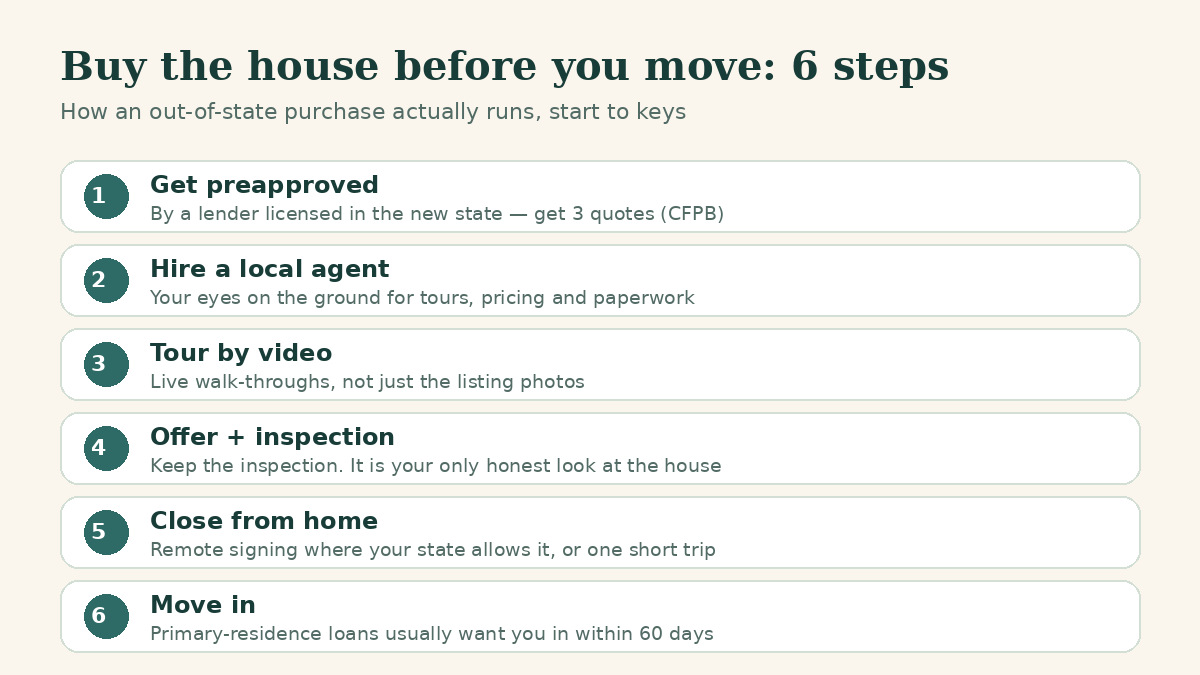
Yes — you can buy a house in another state before you move there, and plenty of people do exactly that. Get preapproved by a lender licensed in the new state, hire a local buyer’s agent, tour homes by live video, keep your inspection, and close remotely or on one short trip.
It feels backwards the first time you say it out loud. You’re signing the biggest paperwork of your life for a house on a street you’ve maybe driven down once. But the process itself is the same one local buyers use — same loan forms, same federal deadlines. What changes is who does the legwork, and how much of it happens on a screen. Here’s the order that works, the cash you actually need, and the traps that catch people who buy from three states away.
Can I buy a house in another state before I move there?
Yes. Nothing in federal mortgage rules says you have to live in a state before you buy a home there. Lenders lend across state lines every day — they just have to be licensed in the state where the house sits, not the state where you sit. You can check any lender or loan officer in the official NMLS Consumer Access database before you share a single pay stub.
One honest catch: a loan for a home you’ll live in — a primary-residence loan — normally comes with an occupancy promise. Most lenders expect you to actually move in within about 60 days of closing. So “buy now, move whenever” doesn’t fly on the cheapest loan terms. Buy on a timeline that ends with you, your boxes, and your driver’s license all landing in the new state within that window. If the house is really a second home or an investment, say so up front. Different loan, different price, no surprises in underwriting.
What should I do first? Get preapproved — in the right state
Start with the money, not the listings. Scrolling homes you can’t yet make an offer on is how people lose a house they loved to a buyer who did the boring part first.
The Consumer Financial Protection Bureau (CFPB) — the federal agency that writes the consumer mortgage rules — tells buyers to get preapprovals from at least three lenders and compare them, and notes that getting all three within a short window should have no major impact on your credit score. A preapproval is the lender checking your income, assets, and credit and putting a real number in a letter. It is not the same as a prequalification, which is mostly the lender taking your word for it. Sellers know the difference.
Two out-of-state specifics:
- Ask the licensing question directly. “Are you licensed to lend in [new state]?” A national lender usually is. A small local bank back home usually isn’t, and finding that out in week three is a miserable surprise.
- Tell them the job story early. Same employer, remote work, a transfer letter, a signed offer in the new state — underwriting will ask how you’ll earn money after the move. A short letter from your employer confirming your role and pay carry on after you relocate settles most of it. What you don’t want is a job change surfacing halfway through underwriting with no paper behind it.
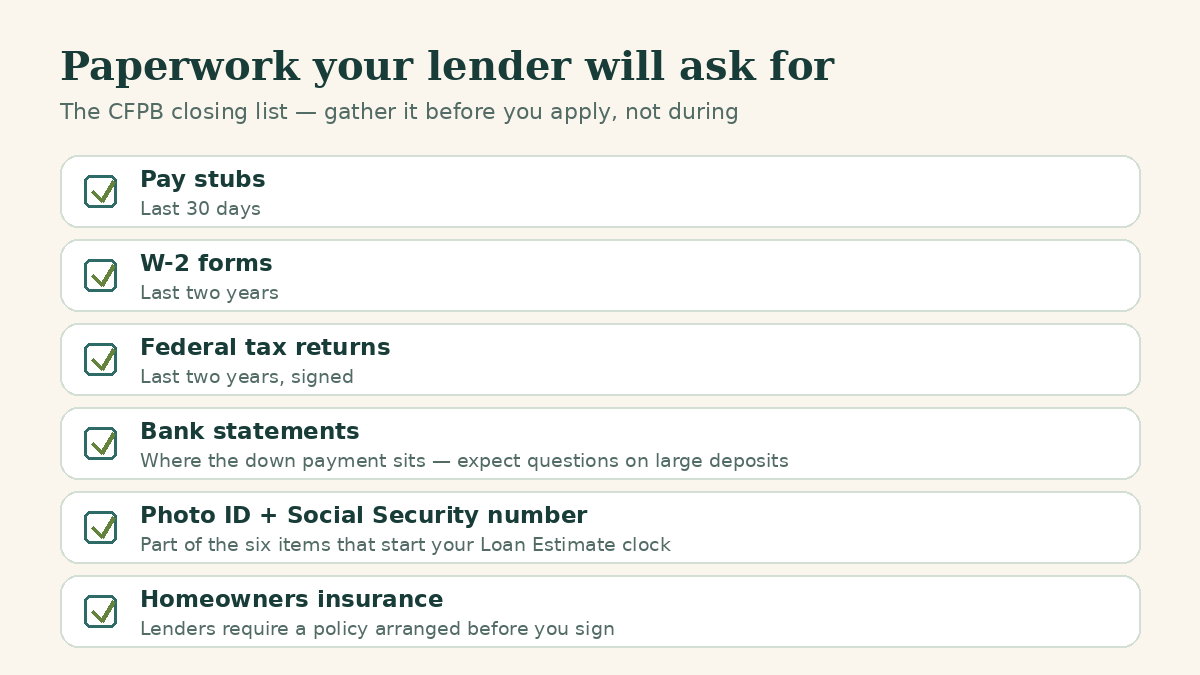
Once you apply, federal timing rules start working for you. Your lender has to send you a Loan Estimate — the standard three-page breakdown of the rate, payment, and closing costs — within three business days of receiving six basic items from you: your name, income, Social Security number, the property address and value, and the loan amount. Get one from each lender and compare them side by side. Same form, same layout, on purpose.
How do I tour and choose a house from far away?
This is where a good local buyer’s agent earns every cent — and since the seller usually pays the commission side of the deal structure you’ll agree in writing, that agent is your eyes, nose, and local common sense.
Ask for tours like this:
- Live video, not a highlight reel. Listing photos are taken on the house’s best day ever. A live walk-through lets you say “slow down — open that closet, point the camera at the ceiling in the bathroom, stand in the street so I can hear the road.”
- The unglamorous pass. Water heater age, the electrical panel, the yard after the sprinklers, the slope of the driveway. None of it photographs well. All of it costs money.
- Numbers before feelings. Our state compare tool puts the two states side by side — cost of living, rent, home values, income — and the state pages give you the local picture. Run your shortlist through the rent vs. buy calculator too: in some markets, renting for a year while you learn the area is genuinely the cheaper play, and it’s better to know that before an offer, not after.
And plan one trip if you possibly can. Not for the first look — for the final one. A weekend spent driving the neighbourhood at 8 a.m. and 10 p.m., timing the commute, and finding the grocery store has saved more buyers from a bad purchase than any report. If a trip truly isn’t possible, the inspection below matters twice as much.
How much cash do I actually need?
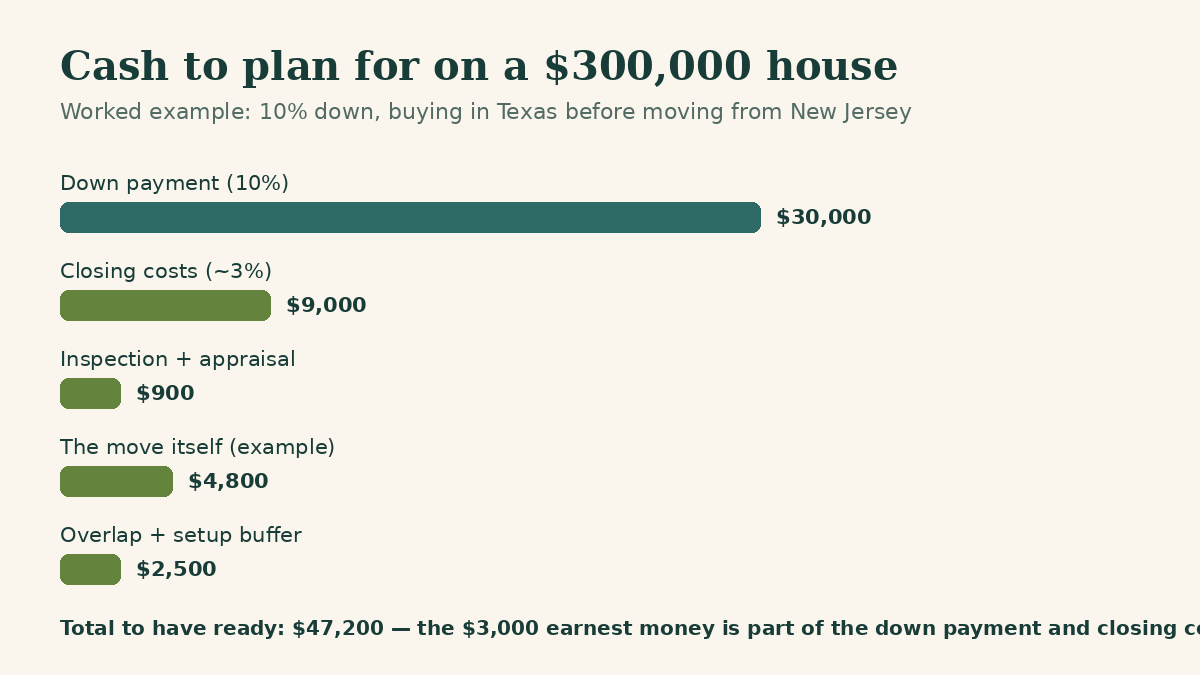
More than the down payment — that’s the short answer, and the one that wrecks budgets. Freddie Mac puts typical closing costs at about 2% to 5% of the home’s price, on top of the down payment. Then there’s the move itself, and a month or so of overlap while two households briefly exist at once.
Here’s a worked example. A family buying at $300,000 — a little above the Texas median home value of $283,800 in the Census data our compare pages use — moving from New Jersey:
| Cash item | Amount | When it’s due |
|---|---|---|
| Down payment (10%) | $30,000 | At closing |
| Closing costs (about 3%) | $9,000 | At closing |
| Earnest money (1%) | $3,000 | Right after the offer is accepted — credited toward the two lines above, not extra |
| Home inspection + appraisal | $900 | During the contract period, before closing |
| The move itself (example) | $4,800 | Around moving day |
| Overlap + setup buffer | $2,500 | First month — deposits, overlap rent or mortgage timing, basics |
Total to have ready: about $47,200, with the $3,000 earnest money paid early as part of it. The moving line is the wobbliest number here — distance and how much you own swing it hard — so price your own route with the moving budget calculator and check it against our cost to move out of state breakdown before you lock a savings target.
What does the timeline look like?
About ten weeks, start to keys, for a typical financed purchase where nothing goes sideways:
| When | What happens |
|---|---|
| Weeks 1–2 | Preapprovals from three lenders; pick one; agent hired |
| Week 3 | Video tours; shortlist down to two or three houses |
| Weeks 4–5 | Offer accepted; earnest money in; contract clock starts |
| Week 6 | Home inspection; lender orders the appraisal |
| Weeks 7–9 | Underwriting; paperwork requests; insurance arranged |
| Week 10 | Closing Disclosure lands at least 3 business days before closing day; sign; keys |
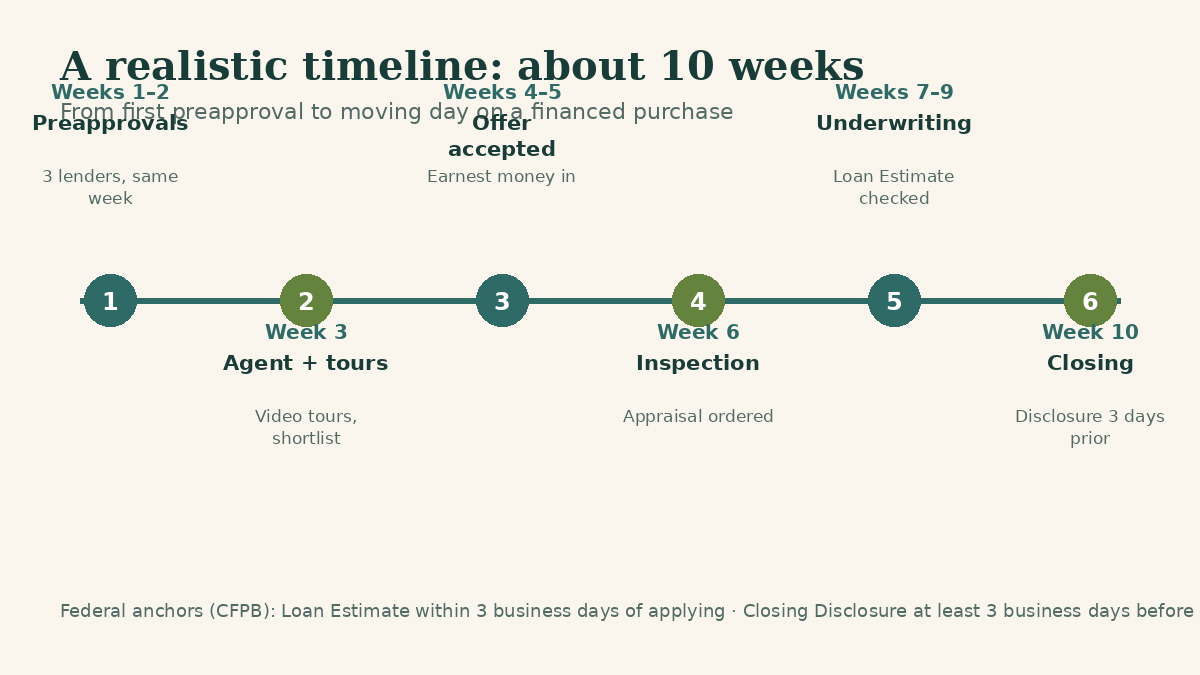
Two of those dates are protected by federal rule, and they’re worth knowing cold. You already met the first: the Loan Estimate within three business days of applying. The second is the Closing Disclosure — the final, five-page version of your loan terms and costs — which your lender must get to you at least three business days before closing. The CFPB built that window so you can compare the final numbers against your Loan Estimate line by line. Use it. If a fee jumped, that’s your moment to ask, not after the wire has gone.
Should I buy before moving, or rent first?
The honest answer: it depends on how well you know the place, and anyone who gives you a flat rule is selling something.
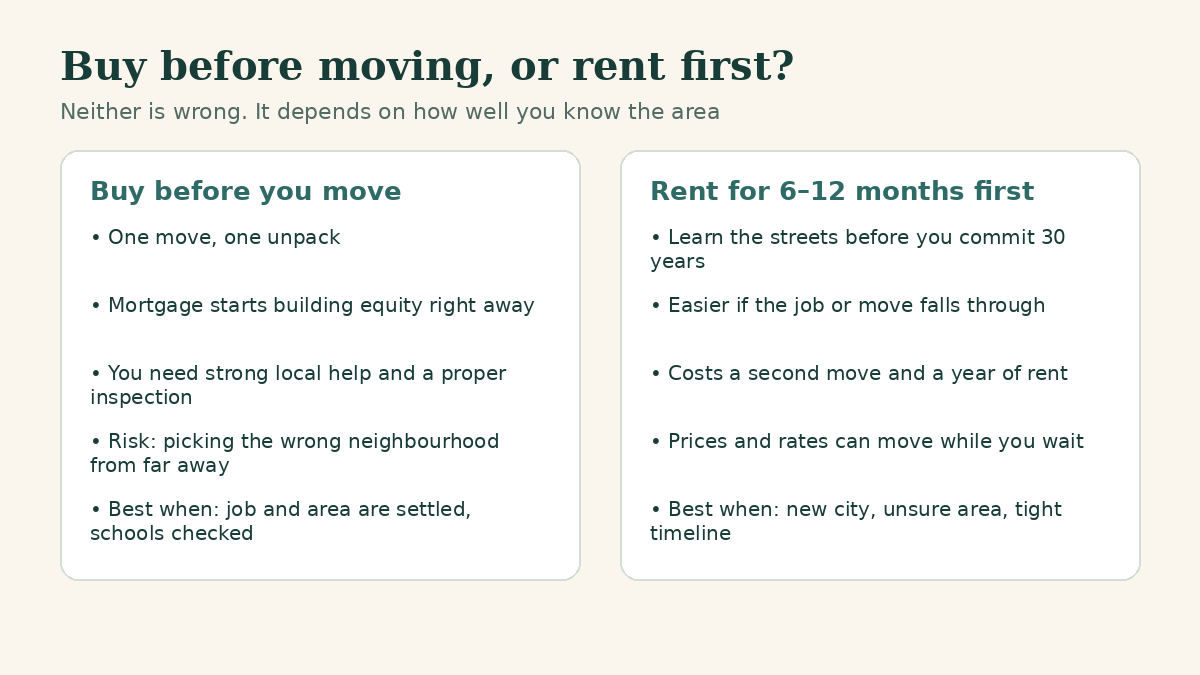
Buying first wins when the destination is settled — job confirmed, area known, schools checked, a prior visit under your belt. Renting first wins when the city is new to you, the job is probationary, or the whole move might unwind in six months. Plenty of families split it: one partner moves ahead into a short rental while the other finishes out the old lease and the house hunt runs properly. There’s no prize for doing it the hard way.
Whichever route you pick, the settling-in work is the same once you land: work through the moving out of state checklist, set up mail forwarding early — our guide to how long mail forwarding lasts explains the 12-month clock — and use the first 30 days after moving plan for the licence, registration, and voter updates.
What can go wrong when you buy from far away?
Four things, mostly. All avoidable.
- Waiving the inspection to win the house. Sellers love it; distant buyers regret it. You are the buyer least able to spot a problem in person, which makes you the buyer who needs the inspection most. A general inspection is a few hundred dollars against a roof or a sewer line that costs five figures.
- Wire fraud at closing. The CFPB specifically warns buyers about mortgage closing scams: a fake email, dressed up to look like your agent or title company, changes the wiring instructions days before closing. People have lost their entire down payment this way. Rule in our house: never wire money off emailed instructions alone. Call the title company on a number you already had — not one from the email — and confirm before a dollar moves.
- Insurance left to the last week. Your lender will require a homeowners policy in place before you sign, per the CFPB’s closing steps. In some states and coastal areas, quotes take time or come back higher than expected. Get quotes during underwriting, not after.
- A quiet job or credit change. New car, new credit card, a resignation with nothing in writing behind it — lenders re-check before closing, and any of these can stall or sink the loan at the worst possible moment. Freeze your financial life between offer and keys. Boring is good.
Buying in Texas, like our example family? Start with the Texas state page and the New Jersey to Texas move page for the state-specific deadlines waiting for you on the other side.
Frequently asked questions
Can I buy a house in another state before moving there?
Yes. There is no rule that you must already live in the state. Your lender must be licensed in the state where the house is, and on a primary-residence loan you will generally be expected to move in within about 60 days of closing.
How do I buy a house in another state before moving, step by step?
Get preapproved by a lender licensed in the new state, hire a local buyer’s agent, tour by live video, make an offer with an inspection, work through underwriting, review the Closing Disclosure in its three-business-day window, then close remotely where allowed or on one short trip.
Can I close on a house in another state without travelling there?
Often, yes. Many closings can be handled with overnighted documents, a mobile notary, a power of attorney, or remote online notarisation — but which options are legal depends on the state and the lender. Ask your lender and the title company at the start, not in closing week.
How much money do I need to buy a house before moving?
Your down payment, plus closing costs of roughly 2% to 5% of the price, plus inspection and appraisal fees, the cost of the move itself, and a buffer for the overlap month. On a $300,000 house with 10% down, that worked out to about $47,200 in our example.
Is it better to rent first when moving to another state?
If you don’t know the area or the move might not stick, renting for 6 to 12 months is usually the safer call. If the job, area, and schools are settled, buying before you move saves a second move. The rent vs. buy calculator will run your own numbers.
Do I need a real estate agent in the state I’m moving to?
You need local representation you trust — an agent licensed in that state who will tour homes live on video, price against local sales, and flag what photos hide. Interview two or three by phone and ask directly how they handle out-of-state buyers.
Sources
- Consumer Financial Protection Bureau — Shopping for a Mortgage: https://www.consumerfinance.gov/consumer-tools/mortgages/shopping-for-a-mortgage/ (compare at least three lenders; get at least three preapprovals; preapprovals gathered in a short window should have no major credit impact)
- Consumer Financial Protection Bureau — Loan Estimate and Closing Disclosure: https://www.consumerfinance.gov/archive/blog/loan-estimate-and-closing-disclosure-choose-right-home-loans/ (Loan Estimate within three business days of application; Closing Disclosure at least three business days before closing)
- Consumer Financial Protection Bureau — The essential steps to close on your home: https://www.consumerfinance.gov/archive/blog/essential-steps-close-your-home-confidence/ (documents lenders ask for; homeowners insurance arranged before signing; mortgage closing scam warning)
- Freddie Mac — closing costs typically 2% to 5% of the home’s purchase price (via CFPB/Freddie Mac buyer guidance)
- NMLS Consumer Access — https://www.nmlsconsumeraccess.org/ (official registry to verify a lender or loan officer is licensed in the state where the home is)
- U.S. Census Bureau, American Community Survey — median home values used by the Out of State Guide compare pages (Texas $283,800)
Planning information only, not financial or legal advice. Loan terms, occupancy rules, and closing options vary by lender and state — confirm the details on your own Loan Estimate and with your lender before you commit.