How Much Does a Moving Company Cost in 2026?
A local move with a moving company usually costs around $1,300 to $1,400 on average, while an out-of-state move depends on weight and distance and can run from a couple of thousand dollars to well over $10,000. Published averages disagree a lot, so the useful question is not “what is the average?” but “which range fits my move?”
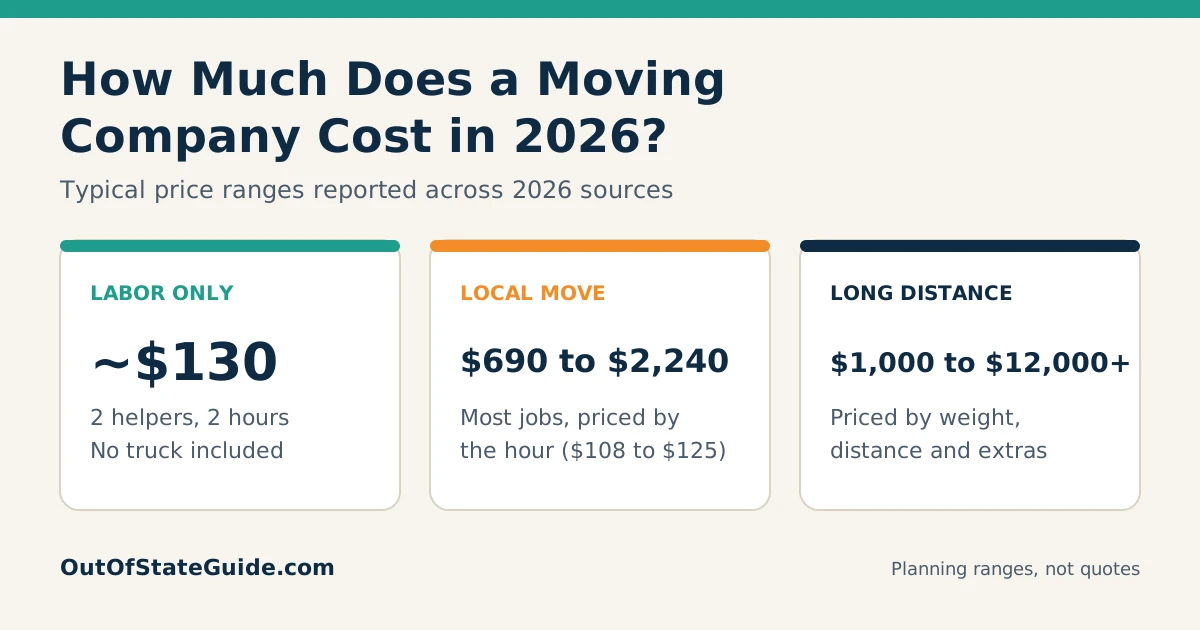
Most local jobs fall between $690 and $2,240, according to LawnStarter’s 2026 data. For longer trips, moveBuddha’s 2026 data shows long-distance moves from $1,000 to $12,000 or more. That spread is real. A studio moving 200 miles and a four-bedroom house crossing the country are completely different jobs.
This guide shows how movers build a price, what moves the number, which fees show up late, and how to read an estimate so the final bill does not surprise you. If you are trying to work out how much movers cost, or how much it costs to hire a moving company for your own move, start with the table below, then match your move to the right pricing model. For the wider picture, see our guide to moving costs explained.
Moving Company Cost at a Glance (2026)
| Move type | How it is priced | Typical reported range |
|---|---|---|
| Labor only (loading help) | Per hour, per helper | About $130 for two helpers for two hours (MovingHelp) |
| Local full-service | Hourly rate, crew size, truck | Roughly $690 to $2,240 for most jobs |
| Long-distance or interstate | Weight (or volume) plus distance | $1,000 to $12,000+ by home size and route |
Treat these as planning ranges, not quotes. Your inventory, route and dates decide where you land. To test your own route, try our moving cost by distance tool.
How Movers Price a Move
Local and long-distance moves use different math, so the first step is knowing which one you have.
Local Moves Are Priced by Time
You pay an hourly rate for a crew and a truck. Thumbtack reports that local movers charge about $108 to $125 per hour on average. Time depends on how much you own, how far the truck travels, how many floors you have and how many people are on the crew.
Long-Distance Moves Are Priced by Weight and Miles
Your belongings are weighed, and the bill follows the weight, the distance and any extra services. On moving day the carrier typically weighs the truck empty, loads your goods, then weighs it again on a certified scale.
An older rule of thumb puts long-haul pricing at roughly $0.50 to $0.70 per pound for every 1,000 miles. It is dated, so use it only for a sense of scale. A 6,000 pound shipment over 1,000 miles would land around $3,000 to $4,200 before packing, stairs, fuel or other extras. That is simple arithmetic from the rule of thumb, not a quote.
What Changes the Price the Most
Weight and Volume
More belongings mean more truck space, more labor hours and more fuel. Decluttering before the in-home survey is the surest way to cut a long-distance bill.
Distance and Season
Longer routes cost more, though not in a straight line. A 3,000 mile move does not cost ten times as much as a 300 mile move. Summer is the expensive season. One carrier notes that the same 1,000 mile, 10,000 pound move costs considerably more in July than in January.
Access at Both Homes
Stairs, elevators, long walks from the truck to the door and tight streets add time or fees.
Extra Services
Packing is usually the biggest add-on. Others include furniture disassembly, appliance prep and specialty items such as pianos.
Fuel and Labor Costs
One industry source reported prices rising about 21% by July 2026 because of fuel costs. That is one company’s figure, so treat it as a signal rather than a market fact.
Moving Company Cost by Home Size
Published tables differ, so here are two sources side by side. Lugg’s 2026 compilation lists a studio or one bedroom at $450 to $900 locally and $1,500 to $3,200 over 1,000+ miles. A two bedroom runs $900 to $1,600 locally and $3,500 to $6,000 over 1,000+ miles.
For a shorter interstate hop, moveBuddha lists $1,165 to $2,650 for a studio or one bedroom and $2,650 to $4,385 for two to three bedrooms at 150 to 250 miles.
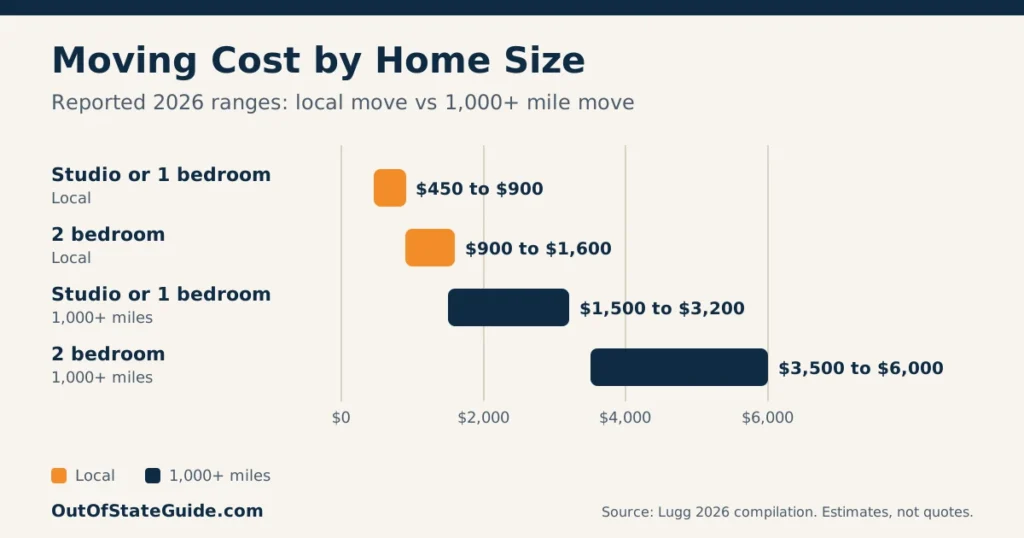
The pattern matters more than any single number. Each extra bedroom adds weight, and long distance multiplies the effect. Our moving budget calculator turns that into a full budget with deposits, travel and a reserve.
Fees That Do Not Appear in the Headline Price
Ask about these before you sign:
- Packing and unpacking labor, plus materials
- Stair, elevator and long carry charges
- Shuttle fees when a big truck cannot reach your door
- Fuel or distance surcharges
- Storage in transit if delivery dates do not line up (check typical prices with our storage cost calculator)
- Extra valuation (insurance) coverage
- Tips, which are optional but common. One consumer site suggests $5 to $10 per mover per hour
How to Read a Moving Estimate
This is where people lose the most money. For interstate moves, federal rules apply, so ask for the estimate type by name.
Binding Estimate
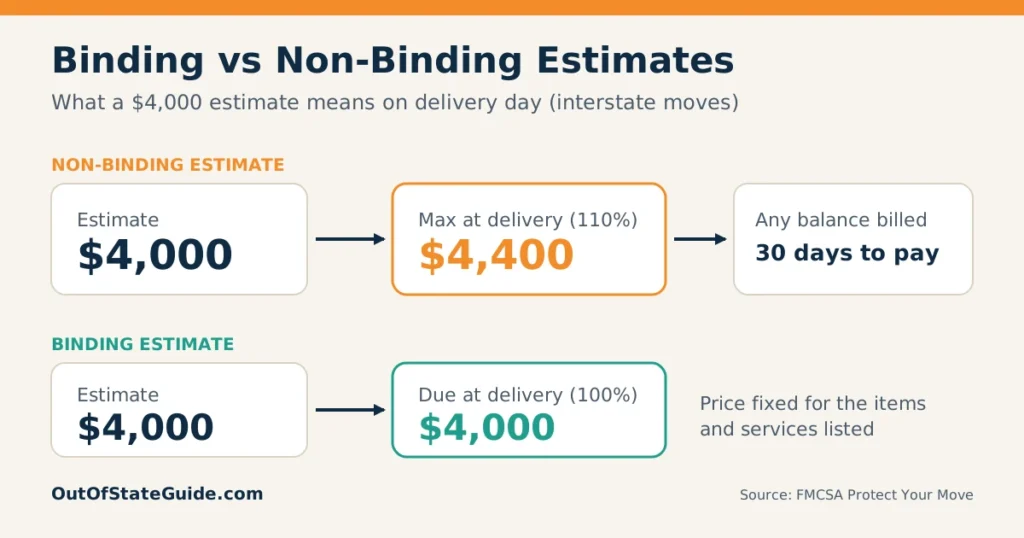
The price is fixed for the items and services listed. You pay 100% of a binding estimate at delivery. A mover may charge a fee to prepare one.
Non-Binding Estimate
This is the mover’s best guess. The final charge follows the actual weight and the tariff in effect. Even so, the mover cannot require more than 110% of the non-binding estimate at delivery, and the remaining balance can be billed later with 30 days to pay. Movers cannot hold your items hostage over that balance. FMCSA also says a mover cannot charge you for a non-binding estimate.
So a $4,000 non-binding estimate means a mover can demand up to $4,400 at delivery. Charges for impracticable operations at delivery cannot exceed 15% of the other charges due at delivery.
In-State Moves Follow State Rules
The federal rules above apply to interstate moves. For a move inside one state, check your state’s rules. Maryland, for example, caps charges at 125% of a non-binding estimate for in-state moves.
Full-Service Movers vs Other Options
| Option | Best for | Cost pattern | Trade-off |
|---|---|---|---|
| Full-service movers | Big or long-distance moves | Highest | Least effort |
| Labor only | You already have a truck or container | Per hour, per helper | You handle the truck |
| Rental truck | Short local moves, tight budgets | Rental plus fuel and mileage | You do all the work |
| Moving container | Flexible timelines | Often between the two | You load and unload |
Ways to Lower the Bill
- Declutter before the survey, since less weight means a lower price.
- Move off-peak: mid-month, mid-week and outside summer.
- Compare quotes of the same estimate type. A binding quote and a non-binding quote are not comparable.
- Pack yourself and let the crew only load.
- Book early. Same-day labor costs more than helpers found weeks or months ahead.
Mistakes That Inflate Moving Budgets
Accepting a Quote Without a Survey
FMCSA guidance lists an estimate given by phone or internet, sight unseen, as a red flag. Ask for an in-person or video survey.
Comparing Only the Bottom Line
A low number often leaves out packing, stairs or fuel. Compare line by line.
Skipping the Paperwork
Check that the company is registered with FMCSA and gives you the “Your Rights and Responsibilities When You Move” booklet. For a fuller vetting process, read how to hire interstate movers.
Forgetting Costs Outside the Mover’s Bill
Deposits, utility setup and car transport are not part of the mover’s invoice.
Checklist Before You Hire a Moving Company
- Get three written quotes of the same estimate type.
- Verify the USDOT number and FMCSA registration.
- Confirm the pickup and delivery window in writing.
- Ask which fees are not included.
- Ask how weight is measured and whether you can watch a reweigh.
- Photograph valuables and keep a signed inventory.
- Keep funds ready for the delivery payment limit under your estimate type.
What to Do Next
Use the ranges above to filter quotes, then collect three binding or well-documented non-binding estimates. If one is far below the rest, ask what it leaves out. If you are moving to a new state, compare housing, tax and insurance costs at the same time, because the cheapest mover does not always mean the cheapest move. Then follow our moving out of state checklist so nothing slips.
Cost figures are estimates based on 2026 published sources and vary by company and route. Always get a written quote.
Frequently Asked Questions
How much does a moving company cost per hour?
For local moves, Thumbtack reports about $108 to $125 per hour on average. Labor-only help is cheaper per hour but does not include a truck.
How much does it cost to hire a moving company for a long-distance move?
Reported figures range from about $1,000 to $12,000 or more, depending on weight and miles. A price below a few thousand dollars usually means a small home or a short interstate hop.
Is a binding or non-binding estimate cheaper?
Neither is automatically cheaper. A binding estimate fixes the price. A non-binding one can end up higher or lower, with the 110% limit applying at delivery.
Why do online averages for moving costs disagree so much?
They mix local and interstate jobs, small and large homes, and different data sources. Some are real quotes and some are vendor estimates.
Can a mover hold my belongings for extra money?
Under the 110% rule, a mover must deliver once you pay up to 110% of a non-binding estimate. The rest can be billed later.
When is moving cheapest?
Usually off-peak: outside summer, and mid-week or mid-month.
Is it cheaper to rent a truck or hire movers?
A rental truck is often cheaper for short local moves, but it adds your labor, fuel and risk. For long distances, compare a mover quote and a container before deciding. Our DIY vs movers calculator and guide to truck and container options can help.
Do I need to tip movers?
Tipping is optional. One consumer source suggests $5 to $10 per mover per hour.
Sources
- FMCSA Protect Your Move, estimates: https://www.fmcsa.dot.gov/protect-your-move/how-to/subpartD
- FMCSA, what is a binding estimate: https://www.fmcsa.dot.gov/consumer-protection/protect-your-move/what-binding-move-estimate
- 49 CFR 375.401: https://www.law.cornell.edu/cfr/text/49/375.401
- Maryland Attorney General moving guide: https://www.marylandattorneygeneral.gov/CPD%20Documents/Tips-Publications/102.pdf
- Thumbtack, how much do movers cost: https://www.thumbtack.com/p/moving-companies-prices
- moveBuddha, moving estimates: https://www.movebuddha.com/?p=1071179
- LawnStarter, how much do movers cost: https://www.lawnstarter.com/blog/?p=82954